North Carolina area codes include 336 and 743 for the Piedmont Triad, 910 and 472 for the southeast, 919 and 984 for the Triangle, and 252 for the northeast. Charlotte uses 704 and 980, while much of western North Carolina uses 828. Start with the regional reference below to place a number geographically (statewide area-code map, 472 overlay announcement).
North Carolina area codes by region and city
Reviewed October 18, 2026. Read paired codes as sharing a coverage area, rather than marking different neighborhoods. The cities below are orientation points, not exhaustive coverage lists. Telephone exchange boundaries can cross county boundaries, so a county name alone may not settle which code applies to a particular number.
| Area code or pair | North Carolina region | Familiar city reference |
|---|---|---|
| 336 / 743 | Piedmont Triad and surrounding communities | Greensboro, Winston-Salem, High Point |
| 910 / 472 | Southeastern North Carolina | Wilmington, Fayetteville, Jacksonville |
| 919 / 984 | Triangle and nearby east-central communities | Raleigh, Durham, Chapel Hill |
| 252 | Northeastern and eastern North Carolina | Greenville, New Bern, Elizabeth City |
| 704 / 980 | Charlotte and surrounding south-central communities | Charlotte, Concord, Gastonia |
| 828 | Western mountains and foothills | Asheville, Hickory, Hendersonville |
For a closer boundary view, open the official map linked above. Its October 2014 date matters: it shows the southeastern territory as 910, before the addition of 472. Use the commission's later overlay announcement for that shared-code relationship, rather than treating the older map as a complete current code list.
336 and 743 identify the Triad region
The 336 area code serves Greensboro, Winston-Salem, High Point, Burlington, Asheboro, and surrounding communities. Its overlay, 743, covers the same territory. New 743 assignments became available May 23, 2016, so a 743 number can belong to a nearby organization just as a 336 number can (Triad dialing notice).
The useful distinction is Triad versus Triangle: Greensboro belongs with the Triad lookup, while Raleigh belongs with the Triangle lookup. For background on the newer Triad code's local reception, read our 743 adoption article after locating the number's region.
910 and 472 identify the southeast
The 910 area code covers southeastern North Carolina, including Fayetteville, Jacksonville, Lumberton, and Wilmington. The 472 overlay serves that same geographic area. It does not identify a separate coastal strip or a different side of Wilmington.
October 7, 2022, was the announced date from which customers requesting new service or another line could receive 472. Existing 910 customers could keep their numbers. When updating a contact record, copy the caller's actual area code instead of substituting the older code because the city looks familiar.
919 and 984 identify the Triangle
Raleigh, Durham, and Chapel Hill sit within the 919/984 region. Both codes are relevant when looking up a Triangle number; neither should be treated as identifying only one of those cities. The coverage also extends beyond those three familiar reference points.
The commission's numbering report documents 984 as an overlay for the existing 919 region in and around Raleigh. For someone maintaining a directory, that means accepting both codes rather than replacing every 984 entry with 919 (commission numbering report).
252 identifies the northeast and eastern communities
The 252 region includes Greenville, New Bern, Elizabeth City, and the Outer Banks. It is the useful starting point for northeastern North Carolina numbers, rather than a general code for the entire coast. Wilmington belongs in the southeastern 910/472 lookup.
704, 980, and 828 complete the western lookup
Charlotte, Concord, and Gastonia fall within the 704/980 region. Those two codes share territory. Use the Charlotte-area exchange map when a nearby community's boundary matters more than its general association with the Charlotte metropolitan area.
Asheville, Hickory, and Hendersonville are western reference points for 828. A significant update accompanies this review: the North Carolina Utilities Commission has approved an all-services distributed overlay for the 828 region. Approval should not be mistaken for a new code already appearing on every western number (commission overlay announcement).
Why one place can have two area codes
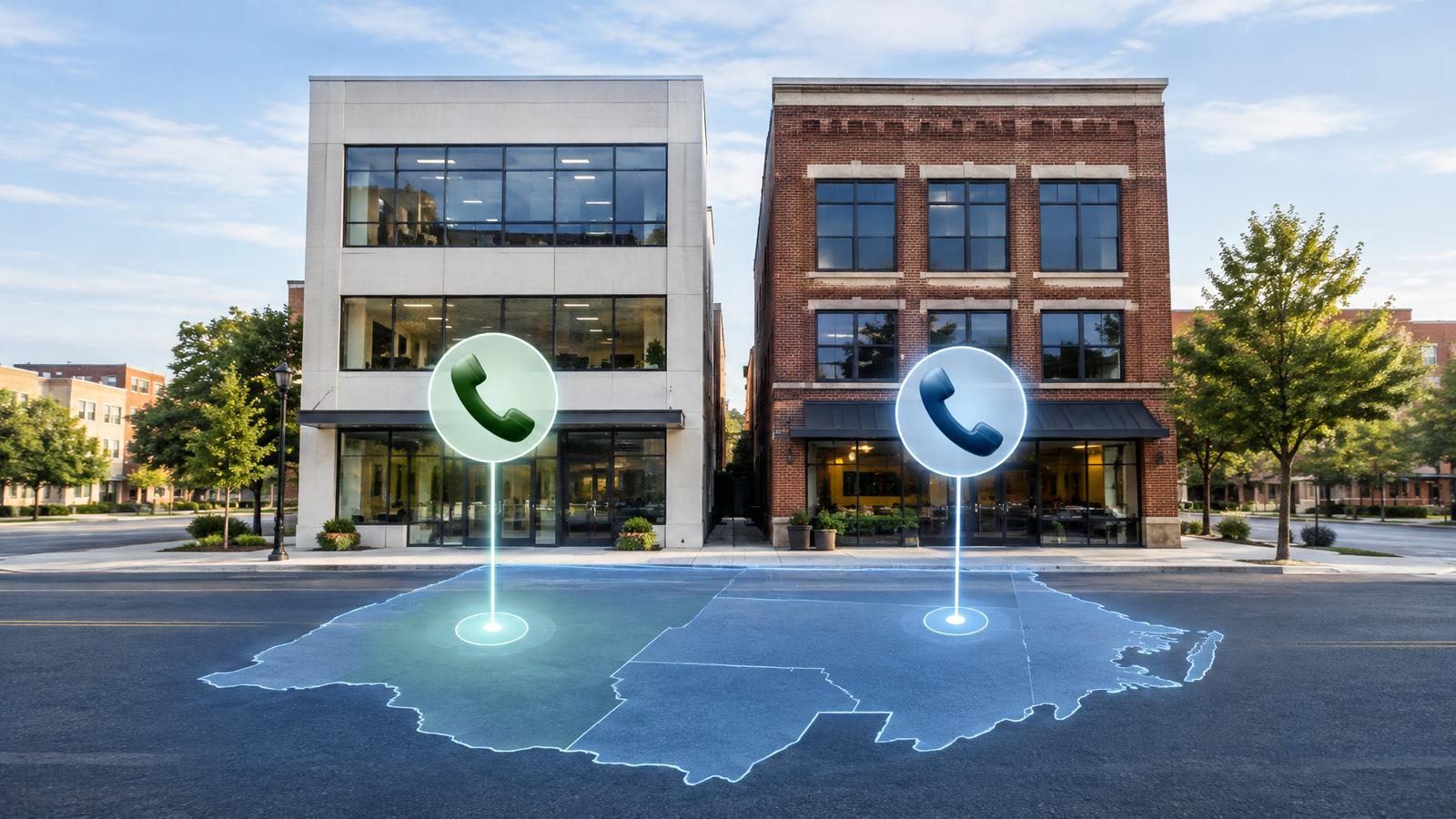
An overlay adds another area code to the same geographic territory. It expands the supply of telephone numbers without requiring everyone with an existing number to adopt the new code. The Triad's 336/743 arrangement illustrates this clearly: the existing 336 numbers remained in place as 743 became available.
Consequently, two neighboring offices can use different area codes without being in different calling regions. Do not use the older code as a shortcut for identifying a longer-established business. To explore how the state's numbering regions developed, read our North Carolina area-code history.
Dial the complete number and distinguish the country code
For the overlay regions covered here, include the three-digit area code when placing local calls. In the Triad, mandatory ten-digit local dialing began April 23, 2016. The commission's 472 guidance likewise calls for the area code and phone number on local calls.
A North American Numbering Plan telephone number contains a three-digit area code followed by a seven-digit local number. When saving a North Carolina contact in international format, place +1 before that complete number. The 1 is the shared country code, not another North Carolina area code (numbering-plan overview).
Use the recipient's complete published number rather than reconstructing it from a city name. For business directories, appointment records, and shared contact lists, storing the full number avoids leaving colleagues to guess which overlay code belongs in front of the local digits.
What an area code cannot tell you about a caller
An area code places a number within a numbering region; it does not establish where the person is standing. Carolina Digital Phone provides a mobile business phone app that lets users make business calls away from their desk, illustrating why a business number and an employee's physical location need not match.
Caller ID also cannot prove identity: names and numbers can be falsified. If an unexpected caller requests money or sensitive information, verify the request through contact details you already trust instead of relying on a familiar North Carolina code (FTC caller-ID guidance).
Use this reference to recognize a number's region, then use the full number and the organization's own contact details to reach the right destination. If your organization needs help planning how employees handle business calls, explore the business phone inquiry form.
Frequently Asked Questions
Does dialing a different North Carolina area code automatically make a call long distance?
No. An overlay does not itself change a local call into a long-distance call. The commission's Triad notice states that existing local calls remain local despite ten-digit dialing. Your service's calling plan determines applicable charges.
Is +1 the area code for North Carolina?
No. +1 is the country code shared across the North American Numbering Plan. A North Carolina number still needs its own three-digit area code and seven-digit local number after it.
Can I keep my North Carolina number when changing providers?
The FCC explains that customers changing providers within the same geographic area can keep their existing number through porting, including between wireline, IP, and wireless providers. Discuss the specific number and proposed service change with the receiving provider (FCC number-porting guidance).