An internet outage at your building does not have to silence your published main number. With a properly configured hosted phone system, the number, auto attendant, queues, and routing rules live in the provider’s cloud platform rather than in equipment inside your office. That separation is the practical foundation of phone system outage recovery.
The difference between a short inconvenience and a day of missed appointments, delayed service calls, or frustrated customers usually comes down to decisions made well before the outage starts.
A practical recovery example: a regional HVAC contractor
Consider a mid-sized HVAC service company in North Carolina’s Piedmont region. It publishes one main number for both emergency service and routine requests. The office has an auto attendant, a small queue for office staff, desk phones, and mobile apps used by field technicians and the on-call dispatcher.
At 8:45 a.m. on a weekday, a utility crew severs a fiber line serving the business park. The office internet drops. Desk phones lose their registration because they can no longer reach the cloud platform. Employees can still use personal cell phones, but customers and property managers continue dialing the company’s main number for heating and cooling issues.
A prepared recovery plan handles the situation in stages:
- The cloud platform remains reachable. Inbound calls still arrive at the hosted system. The auto attendant answers with the normal greeting and options.
- Prebuilt failover rules activate. Emergency selections ring a group that includes the on-call technician’s mobile app and a backup dispatcher working from home. Routine requests go to the office manager’s mobile app, then to a designated cell number after a defined number of rings, and finally to a voicemail that states a clear callback window.
- Staff are informed. The office manager uses a pre-arranged group message outside the office network to confirm the outage, remind technicians to watch their apps, and note that temporary routing is active.
- Normal service returns. When the fiber is restored later that morning, desk phones re-register automatically. The manager places a few external test calls to confirm the queues are working normally, then removes any temporary overrides.
Callers may notice slightly longer ring times. They do not receive a busy signal or a personal cell-phone greeting that makes the business sound closed.
Why the recovery worked
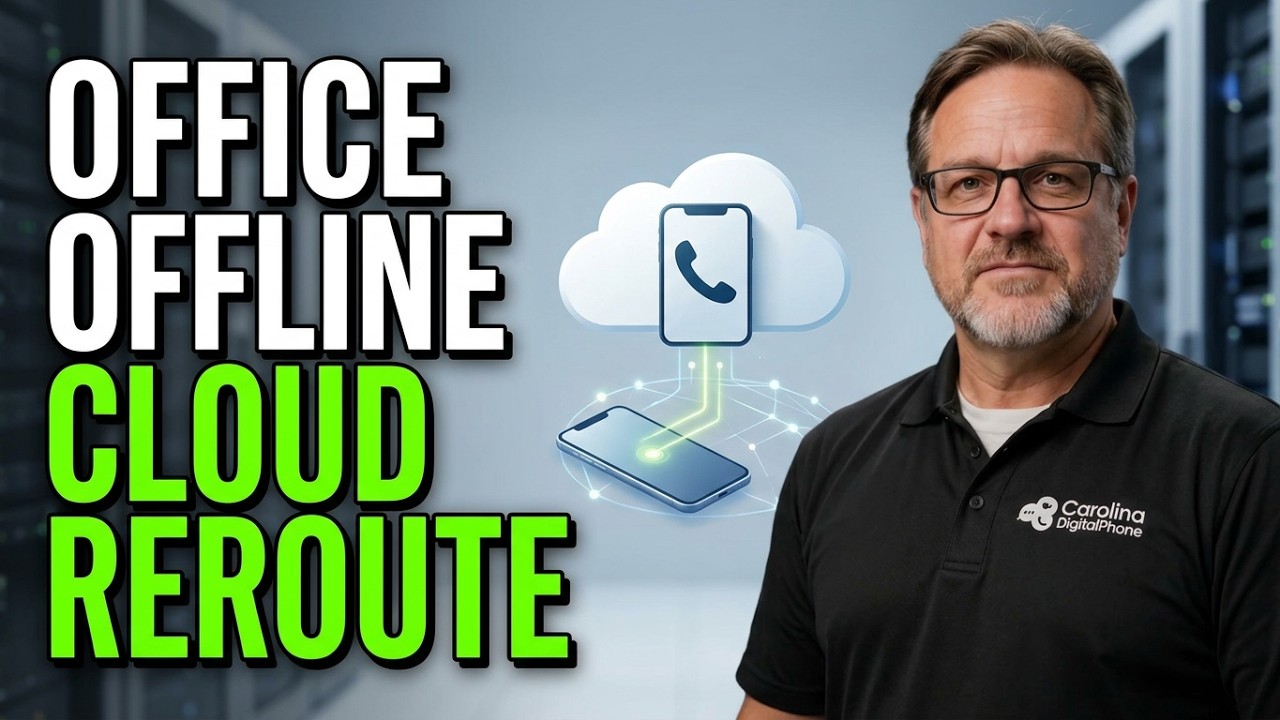
Call handling was not tied only to one physical location. Hosted phone service keeps the main number, auto attendant, voicemail, queues, and routing rules in the provider’s platform. When local phones become unreachable, the preconfigured rules can move calls to mobile apps, another site, or external numbers.
This approach reduces the impact of a single-office internet or power failure. It does not remove every risk. A widespread cellular event can affect mobile destinations. A regional disruption that closes multiple locations can limit available staff. Effective plans include layered options rather than a single fallback.
Carolina Digital Phone runs its hosted platform across facilities in Greensboro, Research Triangle Park, and Dallas, with multiple carriers, diverse fiber paths, and automatic routing between sites. That geographic distribution lowers the chance that a problem in one location becomes a platform-wide calling issue. It does not replace a customer’s own planning for internet, power, staff availability, and procedures.
Build the call flow before the outage
Outage recovery is mainly a decision-making exercise completed in advance. During an active event, people are contacting the internet provider, assisting customers, and coordinating staff. That is not the moment to invent routing rules.
Start by documenting your incoming paths: main numbers, direct-dial numbers, auto attendant options, call queues, ring groups, and any special lines used for alarms, elevators, gates, or paging. Identify which calls truly need a live answer and which can safely go to voicemail with a stated response time.
The most workable plans usually answer these questions:
- Which person or group receives each type of call first when the primary site is unavailable?
- How long should those calls ring before moving to a second option?
- What should callers hear if no live person answers?
- Who has authority to activate temporary forwarding or change the greeting?
- How will staff know the recovery plan is active and when normal routing returns?
Keep daytime recovery paths separate from after-hours routing. Sending every daytime call to an after-hours mailbox can make a staffed business sound closed. A short temporary greeting can acknowledge a service interruption without sharing more operational detail than callers need.
Backup internet changes the outcome for some organizations
A second internet connection—often from a different provider or access method such as fixed wireless or 5G—can keep desk phones operating when the primary circuit fails, provided local power and network equipment remain available. A dual-WAN router or firewall with automatic failover can make the switch largely seamless.
This approach makes sense when real-time calling is central to operations: medical practices, dispatch functions, high-volume customer service teams, schools with safety responsibilities, and public offices that field time-sensitive calls. It requires compatible equipment, configuration, monitoring, and periodic testing.
For offices with modest call volume, cloud-based forwarding to mobile apps or cell phones may be the more practical and cost-effective method. Some organizations use both: backup internet to protect normal desk-phone operations from a single connection failure, and cloud failover when the entire office is inaccessible.
Emergency calling needs separate attention
A continuity plan for ordinary business calls is not the same as an emergency calling plan. Multi-line telephone systems are covered by federal requirements under Kari’s Law and the RAY BAUM’S Act. These address direct dialing of 911 without a prefix or access code and the delivery of dispatchable location information (street address plus floor, room, or similar detail where applicable) so responders can find the caller.
The Federal Communications Commission has published guidance on these obligations for manufacturers, vendors, installers, managers, and operators. Organizations should confirm their system supports direct 911 dialing and accurate location data, and should update location information when devices move or people work remotely. Mobile phones and softphones have their own emergency-calling behavior and should not be treated as an exact substitute for a configured business extension.
Schools, healthcare organizations, and government offices should also map how an outage affects related systems such as paging, bells, door access, alarm systems, and emergency notification tools. Some of these may use separate circuits; others may depend on the same local network as the phones.
For more detail, see the FCC’s overview: Multi-Line Telephone Systems: Can You Connect to 911?.
Test the recovery plan under realistic conditions
A plan that has never been tested is only a set of assumptions. Test it at least once a year and after meaningful changes in staffing, office layout, carriers, or call flow. A practical exercise can include taking a test extension or the office network offline, placing calls from outside your network to the main number and key options, confirming the alternate destinations, and checking caller ID and voicemail behavior.
Ask the people who receive recovery calls whether they can answer, transfer, identify the business properly, and return calls from the mobile app or alternate device. Document what failed—two backup contacts unavailable on the same weekday, a timeout that was too long, or unclear internal notification—and adjust the rules.
Industry guidance on VoIP disaster recovery emphasizes documented procedures, vendor capabilities, and regular testing. Resources such as TechTarget’s overview of VoIP disaster recovery best practices highlight the value of incorporating communications continuity into broader plans.
Clear communication during an outage also matters. Guidance from the Cybersecurity and Infrastructure Security Agency on communicating under pressure stresses predefined roles, factual updates, and backup channels so staff and stakeholders know what is happening and what to do next.
The practical goal
When phones are affected, customers and residents remember whether they could still reach a person who could help. A clear call flow, current backup contacts, accurate emergency location data, and a tested recovery procedure give your team something better than improvisation.
If you would like to review your current call routing, explore failover options, or discuss how a hosted platform can support continuity for your organization, request a quick callback from an onboarding specialist.