
Here is a number most school leaders have never thought about: how many different places on your campus share the same street address. For a typical middle school, it is somewhere past sixty. Sixty rooms, one line on an envelope.
That matters because of what happens when someone on your staff dials 911. For a great many schools, that one line is all the 911 operator is given. I started Carolina Digital Phone in Greensboro in 2000, and schools have been a large part of our work ever since. In my experience, this is the least understood weakness in school safety, and it is one of the least expensive to fix.
We fix it on every school we install. A 911 call from one of our classroom phones carries more than the address. It tells the operator which building, which floor, and which room. This article explains what that looks like in the first few minutes of an emergency, why so many systems still fall short, and how you can check your own school this week without placing a single 911 call.
The short version
- A street address tells responders which campus. It says nothing about which of sixty doors.
- Federal rules expect a school phone system to send a dispatchable location with a 911 call: the address and enough extra detail to locate the person calling.
- Carolina Digital Phone assigns a location to each classroom phone, so the room travels with the call.
- The same moment the call goes out, the staff you pick are told which phone dialed.
- You can audit your own campus in about fifteen minutes. The steps are below.
What does a 911 operator actually receive from a school phone?
One of three things, and only the third is good enough. I think of them as grades.
| Grade | What the operator is given | What happens next |
|---|---|---|
| The wrong address | The district office, or wherever the phone bill is mailed | Help may be sent to a building miles from the emergency |
| The right address, and nothing more | The school’s street address | Responders arrive at the main entrance and have to ask where to go |
| The address and the room | The street address along with the building, floor, and room | Responders head for the nearest door to the person who needs them |
The first grade sounds unlikely. It is more common than you would hope, because older phone systems report the location tied to the account, and the account often belongs to the central office.
The Federal Communications Commission’s term for the third grade is a dispatchable location. It means a confirmed street address along with whatever else it takes to pin down where the caller is, such as a suite, an apartment, or in a school’s case, a room.
What happens in the first minutes after a teacher dials 911?
When the system is set up properly, six things happen, and the first four take only seconds.
- The teacher presses 9, 1, 1. Nothing else. No extra digit to get out of the building, no code, no waiting for a dial tone that sounds different.
- The system looks up that one phone. Not the school. The phone on the wall of that classroom, and the location recorded for it.
- Two messages leave the building together. One is the call itself, carrying the address and the room to the 911 center. The other is an alert to the school’s own people.
- The operator answers already knowing where. The first question can be “What is your emergency?” and not “Where are you?” When the person on the line is a frightened ten-year-old, that difference is everything.
- The office moves. Front office phones show which room dialed. A text reaches the principal and the resource officer on duty. One person heads for the room and another for the closest outside door.
- Responders are met. They pull in to find someone standing at the correct entrance, pointing.
None of that asks the caller to know the address, remember a room number, or stay calm. That is the point. A safety system should not depend on the person having the worst day of their year.
What about after the front office goes home?
This is the part most plans forget. Picture a Thursday in October at 5:40 in the evening.
The office closed two hours ago. The building is far from empty. There is volleyball in the gym, a tutoring group in the media center, and a custodian on the second floor. Out back in the field house, a strength coach is working with six athletes when one of them goes down beside the squat rack and does not get up.
He grabs the wall phone and dials 911. If the school’s alert only rings the front desk, it is ringing in a dark room. If the 911 center only has the street address, the ambulance will stop at a locked front entrance, three hundred yards and one fence from the field house.
On a system built with care, the call says Field House, weight room, south door. The alert skips the empty office and goes to the athletic director’s cell phone and the custodian’s handset, because someone thought about what 5:40 looks like. The custodian has the gate open before the siren is audible.
I am describing an illustration, not a particular school. But every piece of it is a setting that either was chosen on a calm afternoon or was not.
Why do so many school phone systems still send only an address?
Because nobody decided they should. It is the result of five ordinary things piling up over twenty years.
- Old systems shared a few outside lines. Every call left the building looking the same, so one location was all the equipment could report.
- The address on file is the billing address. Whoever set up the account years ago gave the place the invoice goes.
- Phones wander. A handset moves from the library to the counselor’s office over the summer, and its record stays behind.
- Campuses grow. Modular classrooms arrive in August. A wing is renovated and renumbered. The phone system is the last to hear about it.
- Nobody owns the list. Facilities assumes technology has it. Technology assumes the phone company has it. The phone company has what it was told in 2011.
If any of those sound familiar, you are in good company. It is also why a new phone system does not solve the problem by showing up. Somebody has to do the unglamorous work of writing down where every phone is.
What does federal law expect of a school?
Two laws apply to the kind of phone system schools use, and the FCC explains both in its guidance for multi-line telephone systems.
Kari’s Law covers dialing and alerts. A person has to be able to reach 911 with those three digits and nothing in front of them, and the system must notify someone at the site that a 911 call was placed. It applies to systems manufactured, sold, or installed after February 16, 2020.
RAY BAUM’S Act deals with where the caller is. The regulation behind it (47 CFR 9.16) has applied since January 6, 2021 to desk and wall phones that stay put inside a building. Those phones have to send their dispatchable location automatically, without the caller doing anything. A classroom wall phone is exactly that kind of device.
I am a phone man, not a lawyer. How these rules apply to your particular system and its age is a question for your attorney and your safety director. What I can tell you is what the rules are reaching for, and it is the same thing every parent would ask for: that help can find the room.
How does Carolina Digital Phone put the classroom on the call?
By treating the location list as part of the installation, not an afterthought. Here is how we go about it.
We write a location for each phone. Classroom, office, gym, kitchen, field house, bus lot. Each handset gets its own entry in our platform.
We write it for a stranger. “Rm 118” means something to your staff. “East Wing, Room 118, exterior door E3” means something to a paramedic who has never set foot on your campus. If your outside doors are numbered, we use the numbers.
We match your floor plans. Under state law, North Carolina’s public schools already supply building diagrams to their local police and sheriff’s offices. The words in the phone system should be the words on those diagrams, so the officer reading a dispatch and the officer reading a map are looking for the same label.
We set the alerts with you. Who is told during the school day, who is told after 3:30, and who is told in July.
We check it the right way. Testing is arranged with the 911 center, never sprung on it.
Behind all of that is the carrier network that delivers the call. Ours runs through Sinch, a leading 911 call aggregator in the United States, and Carolina Digital Phone holds its own company identifier with NENA, the national 911 association. You can read more about our education phone systems and our hosted phone service for schools.
One caution, because I would rather you hear it from me. What shows on the operator’s screen also depends on the technology your local 911 center runs. So we still tell every school the same thing: train your people to speak their building and room number out loud. The screen backs up the voice, and the voice backs up the screen.
Where do paging and emergency alerts fit?
Right beside 911, because calling for help is only half of an emergency. The other half is telling everyone else in the building what to do.
That is the job of paging and of emergency notification, and they are two different tools. Paging is the voice in the ceiling. It reaches the people inside your walls. Emergency notification reaches further, with texts, emails, and recorded messages for staff and families who are nowhere near a speaker. A school needs both, and it needs to know which one does which job. If you are new to the subject, our article on how IP paging works is a good place to begin.
We recorded a short video about getting your alerts ready before a storm, a fire, or a power failure. Share it with your safety committee.
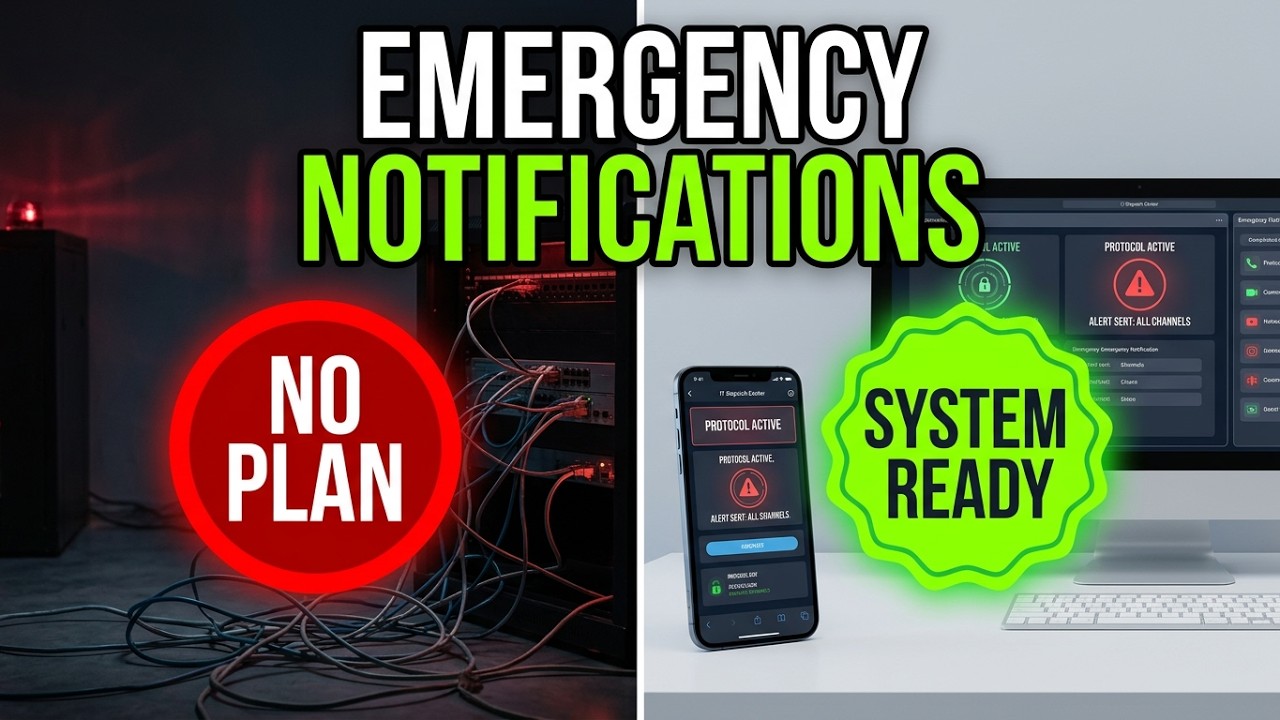
For a full planning guide that covers bell schedules, paging zones, network readiness, and a six-step rollout, see our companion article on Local Business VoIP, VoIP for Schools With Paging and E911 That Works.
How can you check your own school in fifteen minutes?
With a phone call to your provider and a walk down the hall. You do not need to dial 911, and you should not. Unannounced test calls tie up emergency lines.
- Ask for the list. Call your phone provider and request the 911 location on record for every phone at the school. A good provider can send it the same day.
- Count the entries. If the whole campus shares one location, you have your answer already.
- Spot-check five phones. Choose the ones farthest from the front office. Compare what the list says with what is printed on the door.
- Look at your newest spaces. Modular classrooms, a renovated wing, a new field house. These are the places records miss.
- Read the alert list. Who is notified when 911 is dialed? Cross off anyone who no longer works there. Then ask who receives it at 5:40 in the evening.
- Ask about the 9. Have your provider confirm that every phone reaches 911 on three digits alone, with no prefix in front.
- Ask about laptops and cell phone apps. If staff take calls on an app at home, find out what address a 911 call from that app would report.
If the answers are solid, you will sleep better. If they are not, you now know exactly what to ask for. Either way, a principal who has done this knows more about the school’s 911 readiness than most districts do.
Questions school boards ask us
Is a street address enough to satisfy the 911 rules for a school?
For a campus with more than a handful of rooms, an address by itself rarely gives responders what the rules are aiming for. Federal rules call for a dispatchable location, which means enough detail to find the caller. Ask your attorney how the rules apply to your system.
What if the caller hangs up or cannot talk?
The location and a callback number arrive with the call, so the 911 center knows where it came from even if nobody speaks. The school’s own alert has already told your staff which room to check.
What about the ball field, the bus lot, and other places with no phone?
Any phone we install can have a location, including one in a press box or a bus office. A call from a personal cell phone is different. It is located by the wireless carrier, not by the school’s phone system, so staff outdoors should be ready to describe where they are.
Who is alerted when the office is closed?
Whoever you name. Alerts can go to cell phones and to different people at different hours, so an evening or weekend call reaches someone who is actually there.
Will we need new wiring in every classroom?
Usually not. Modern classroom phones run on the school’s data network, the same cabling your computers use. We look at the network during our assessment and tell you plainly if anything needs attention.
How often should the location list be reviewed?
Every time a phone moves, and once before each school year starts. Give the job to one named person, because a list that belongs to everyone is kept by no one.
Talk with people who do this for schools every week
Carolina Digital Phone has a team dedicated to schools and government, and they have their own direct line: (336) 543-0000. Call and ask the question at the top of this article. If we already serve your school, we will show you your list. If we do not, we will tell you what to ask whoever does.
You can also learn more at HostedVoIPforSchools.com, request a quick callback from a local onboarding engineer at HostedBusinessTelephone.com, or get a quote at HostedVoIPPhoneSystem.com.
Keep reading
- VoIP for Schools With Paging and E911 That Works (the planning guide)
- How to assign dispatchable E911 locations
- Must-have school phone safeguards
- Emergency notification system planning steps
- K-12 school phone systems in North Carolina
- SchoolSafety.gov, the federal school safety clearinghouse
- 911.gov, the national 911 program
Nicky Smith founded Carolina Digital Phone in Greensboro in 2000. Published October 9, 2026. It is offered as general guidance and is no substitute for legal counsel.